In 2022, Rhythm Zero was still becoming itself. The windows of the Greenpoint location were papered over, the space mid-construction, the doors not yet open to anyone. Then someone knocked.
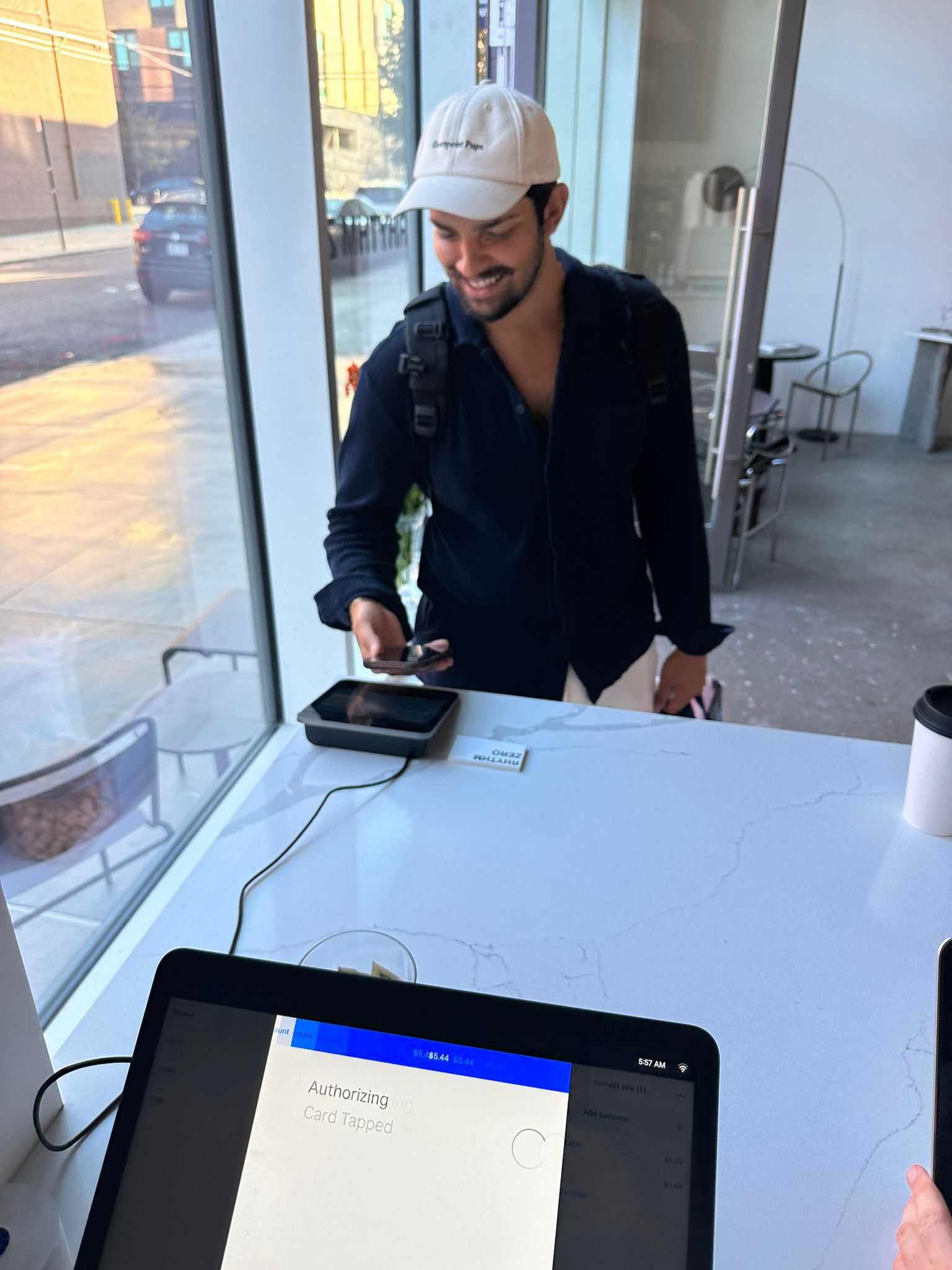
Theo Pinto had walked past, curious about what was being built. Ivana let him in. He looked around, asked questions, and when the cafe finally opened, he was the first through the door. First customer. Iced oat latte. Card tapped.
Three years later, his paintings are on our walls.
The relationship between Theo and Rhythm Zero has grown the way the best ones do, slowly, organically, and with genuine mutual admiration. The Greenpoint location eventually became home to a dedicated installation built around one of his collections, the space styled and arranged to live alongside his work rather than simply display it. It was less a gallery show and more a dialogue between two creative visions sharing the same room.
Theo is a Brazilian-born, Brooklyn-based artist whose work in oil on wood panel explores light, color, and perception. He builds his surfaces through layering, sanding, and tonal refinement until something shifts. The result is paintings that reward sustained attention and slow observation, which is exactly the kind of energy we try to hold in our spaces.
His work has been shown at Cadogan Gallery in London, Nature Morte, 1x1 Gallery, and The Pill, and lives in private collections across the United States, Europe, Latin America, and Asia. It also lives on the walls of Rhythm Zero, where it has always belonged.

.png)
On who encounters the work and where it lives
Theo doesn’t think about the specific place a painting will live while he’s making it. What he holds onto instead is what he hopes someone might experience when they encounter it. A moment of stillness. Presence. A subtle shift in attention.
Showing work at Rhythm Zero has given that intention a particular kind of home. Theo lives directly above the original Greenpoint cafe, and Alex and Ivana are close friends. He’s watched the space become an important part of the neighborhood and community from the beginning. “What they are creating feels naturally aligned with the work,” he says. “They’ve built spaces where people are invited to slow down, connect, and disconnect at the same time.” Someone might encounter one of his paintings there repeatedly, under different light or in a different state of mind, and gradually develop a relationship with it. That, he says, is very close to what the paintings are meant to offer.
.png)
On the influences that still show up today
The earliest was his uncle, Hamilton Aguiar, a painter living in the United States. At sixteen, Theo came to work as his apprentice, spending his days preparing materials, building things in the studio, and watching paintings develop slowly through repetition and patience. That experience gave him a respect for craft that is still fundamental to how he works.
Growing up in Minas Gerais shaped him just as deeply. The vast skies, the intensity of the light, the way the landscape stretches toward the horizon. All of it is still somewhere inside the paintings, even as the work has become completely abstract.
Music and architecture were equally formative. Music taught him that something can affect us deeply without having to explain itself. Architecture taught him to think about proportion, material, atmosphere, and the body’s relationship to space. The paintings grew from all of those influences rather than from painting alone.
On the shift from architecture to painting
There was no single dramatic moment. It was, as Theo describes it, more like gradually admitting something he had known for a long time.
He began at MICA as a sculpture major before moving into architecture and design. After graduating he spent several years creating spatial and experiential projects, continuing to paint alongside that work. Slowly, painting stopped feeling like something he was doing in addition to his career and became the place where all his questions were converging.
Architecture had taught him how to construct an experience. Painting gave him a more intimate and intuitive way of doing it. He could begin without knowing exactly where he would arrive. “Eventually, the work demanded my full attention,” he says. “The shift felt less like leaving architecture behind and more like recognizing that painting had always been where I was headed.”
Photo Support by Frank Frances
.png)
.png)
.png)
.jpg)